
Anyone who has taken even one aerial yoga, hammock, hoop, or floor-conditioning class knows that standard gym clothes behave very differently once your feet leave the ground. A relaxed T-shirt that feels effortless during a warm-up immediately slides over your face the second you invert. A tiny pocket zipper or metal drawstring tip can snag an aerial silk, and a stiff center seam becomes noticeably uncomfortable the moment a hammock wraps across your hips.
Choosing clothing for aerial fitness and flexibility conditioning isn’t about chasing gym trends—it is about protecting your skin, protecting studio apparatus, and removing physical distractions while you focus on control, grip, and alignment. Here is how specific garment construction details directly affect your practice.
Eliminate Hardware and Loose Fabric Before You Climb
Most aerial studios share one non-negotiable safety rule: no zippers, metal clasps, sharp buckles, or exposed hooks. Even a concealed pocket zipper on a jacket or pair of leggings can catch delicate tricot hammock fabric and create micro-tears over time.
Just as important is controlling excess fabric during inversions:
- Skip oversized tees for inverted drills: Unless tucked securely, loose tops shift toward your shoulders in handstands, straddle inversions, and hip hangs.
- Inspect seam thickness: Flat, low-profile seams sit smoothly beneath knee wraps, hip locks, and ankle wraps without leaving raised pressure marks on your skin.
Why Seam Placement and Gussets Matter in Straddles and Hip Hangs
Aerial conditioning, active flexibility training, and hammock inversions put far more tension through the hips and inner thighs than standard upright workouts. That is where two often-overlooked construction details make an immediate difference: front-seam removal and gusset design.
Traditional leggings and shorts have a thick vertical seam running straight up the front rise. Under body weight in a hammock hip hang or deep pancake stretch, that seam can dig in, shift sideways, or cause friction. Switching to fitted bottoms engineered with no front seam and an extended gusset creates a smooth, uninterrupted front panel that moves naturally across wide straddles and splits.
For floor conditioning, warm-ups, and pole-adjacent strength sessions where you want thigh coverage without bulk, no-front-seam 8-inch biker shorts are a practical staple. The longer 8-inch inseam stays anchored along the thigh during leg lifts and seated stretches, while a two-piece high-rise waistband and soft brushed four-way-stretch fabric keep the waist flat without hard hardware.
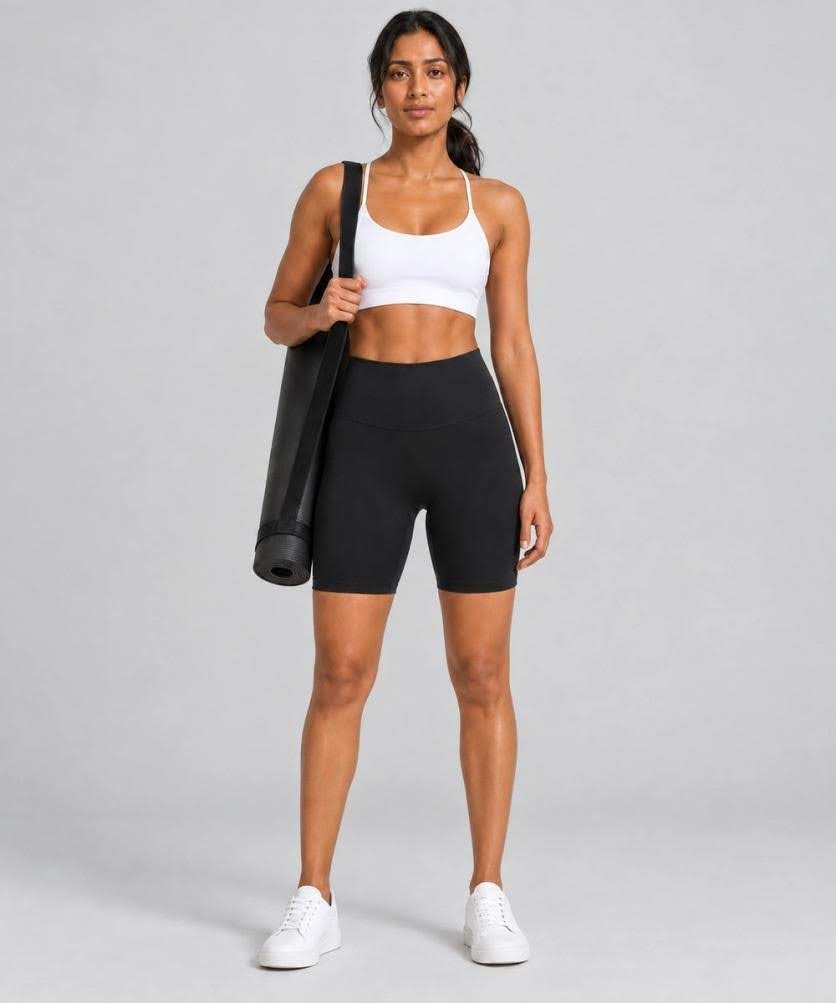
A smooth, no-front-seam front panel paired with an extended gusset prevents digging and friction during deep straddles, floor conditioning, and hip hangs.
Match Leg Coverage to Your Apparatus
One outfit rarely covers every aerial discipline, because skin grip and friction protection pull in opposite directions:
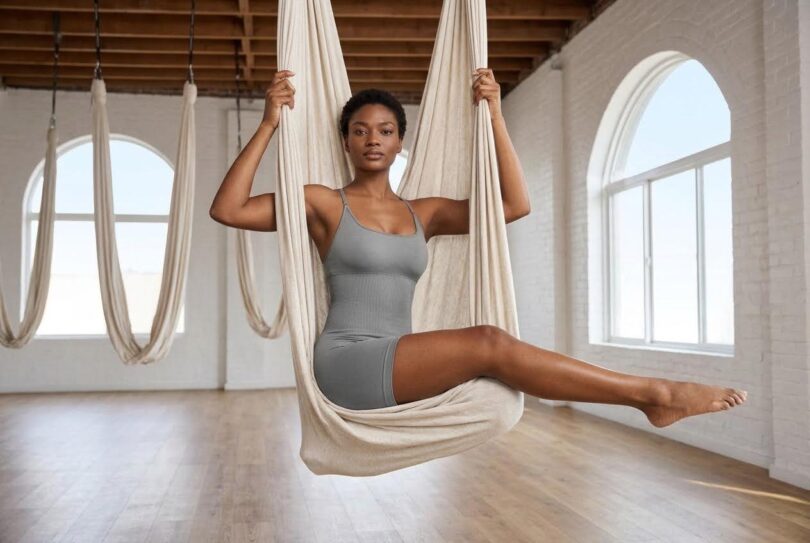
- Aerial silks and aerial hammock (aerial yoga): Full-length or 25-inch close-fitting leggings are usually the safest choice. Covering the backs of the knees and calves helps prevent fabric burn during climbs, knee hangs, and wraps. Look for lightweight four-way-stretch blends—such as Nilit and Lycra fibers—that offer smooth coverage without feeling overly slippery or trapping heat.
- Aerial hoop (lyra) and conditioning drills: Many practitioners layer close-fitting leggings for knee-pit protection, or transition to fitted 8-inch shorts paired with supportive upper layers once skin conditioning improves.
- Pole conditioning and off-apparatus mobility: Strategic skin contact remains essential for grip on the pole, making streamlined shorts and secure one-pieces ideal for warm-ups, floorwork, and cross-training.
Consider a Fitted Unitard for Zero-Gap Inversions
If you are tired of constantly tucking a tank top back into your waistband between sets of inversions, shoulder stands, or hammock flows, a fitted one-piece solves the problem completely. Because the top and bottom are constructed as a single garment, there is no waistband gap to ride up or expose your lower back when you hang upside down.
When evaluating a unitard for aerial or studio conditioning, prioritize three details:
- Adjustable straps and open-back mobility: Aerialists rely heavily on full overhead shoulder flexion and scapular movement. Adjustable crisscross straps let you dial in torso length so the neckline stays secure without pulling on your shoulders.
- Built-in support: Integrated pads remove the need to layer a bulky hook-and-eye bra underneath, which can press uncomfortably into your back against a hoop or floor mat.
- Seamless, high-recovery stretch: High-stretch nylon-spandex fabrics that snap back cleanly after deep extensions keep the silhouette close to the body so nothing catches on wraps.
To check torso fit, sit on the mat and draw one knee toward your chest. If the straps pull at your shoulders or the leg openings ride up, try adjusting the straps or comparing sizes. For mat conditioning, Avensai’s seamless cross-back short unitard is one option, with adjustable crisscross straps, built-in pads, and a smooth, no-front-seam construction in four-way-stretch nylon-spandex.
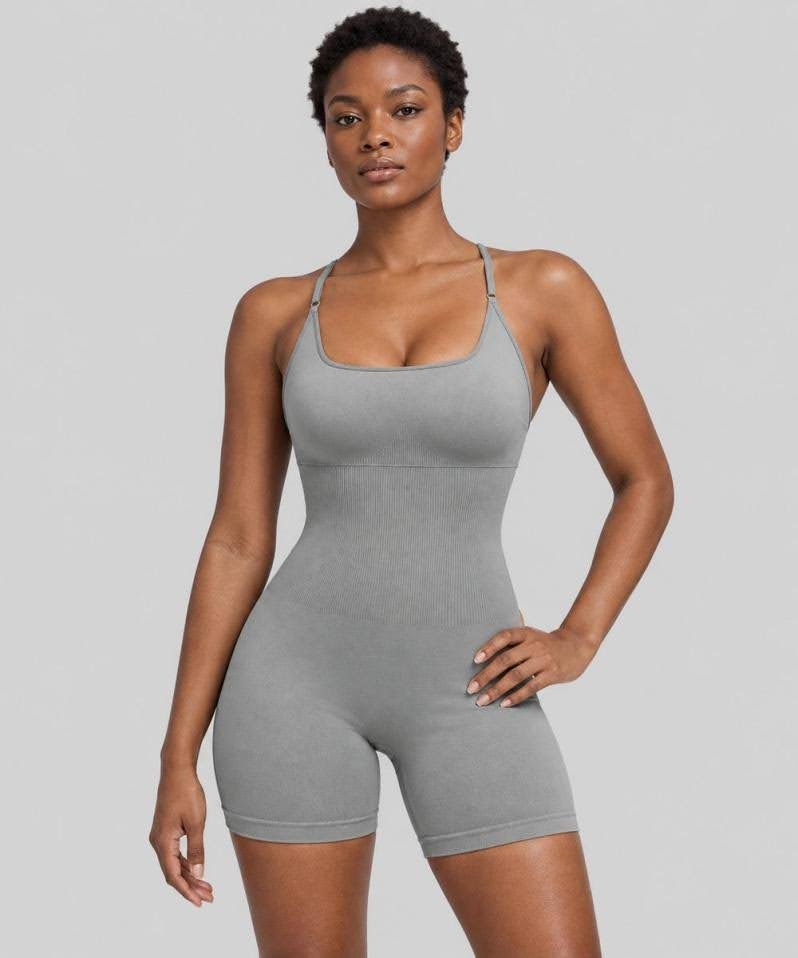
A one-piece, no-front-seam silhouette with built-in pads eliminates shifting waistbands and metal bra clasps during inversions and mat conditioning.
A 60-Second Pre-Class Inversion Fit Test
Before packing a new piece for your next aerial yoga, hammock, or conditioning class, run five quick checks at home:
- Hardware sweep: Run your hands along every pocket, seam, and strap to confirm zero zippers, snaps, or sharp adjusters that could catch on silks.
- Deep straddle check: Sit in a wide straddle and fold forward—verify there is no center seam digging into the front rise and that the gusset stays smooth.
- Upside-down or forward-fold check: Drop into a deep forward fold or downward dog for 15 seconds. Confirm your neckline stays close to your chest and your hem does not slide toward your ribs.
- Full overhead reach: Reach both arms straight overhead and pull down as if climbing a silk; straps should track cleanly across your shoulder blades without slipping or pinching.
- Smart warm-up layering: Pack an easy-to-remove long sleeve or grip socks for floor mobility before stepping onto your apparatus.
Great aerial training depends on trust—trust in your grip, your breath, and your body positioning. Choosing activewear built around seam comfort, hardware-free construction, and reliable stretch recovery lets you keep your focus in the air instead of on your clothes.