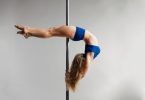
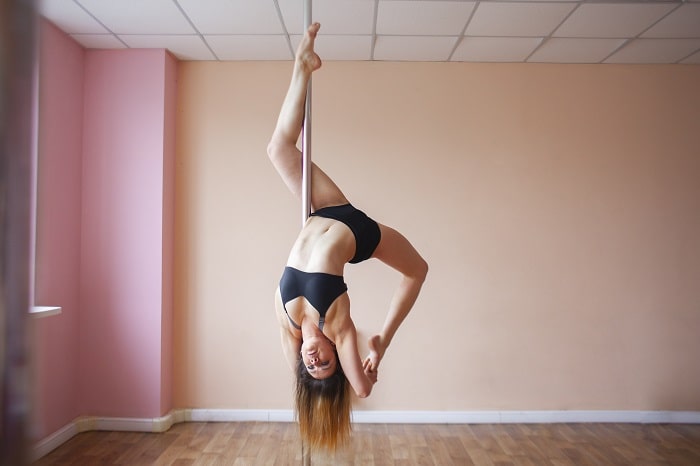

Ask someone who has never taken a class what pole is, and you’ll usually get an answer about choreography and flexibility.
Then they take a class. Ten minutes in, their forearms are burning and they cannot work out why they’re already out of breath, because nothing they did looked like cardio. That’s the part outsiders miss. A climb is a pull-up you do with your legs still attached to a moving problem. A sit is an isometric hold you’re supposed to smile through. An invert asks your core, hips, shoulders, and grip to cooperate at the same moment, and the first fifteen attempts don’t work.
So when people ask how many calories pole dancing burns, the honest starting point is that pole doesn’t behave like the activities calorie charts were built for.
Why pole resists a clean number
A treadmill session is a flat line. A pole class is a heart rate graph that looks like a mountain range.
You warm up and mobilize. You learn a sequence at half speed. You attempt a shoulder mount six times, and between attempts you rest, because attempting it tired is how people get hurt. You chalk up. Someone films you. You watch the video. You try again. Then conditioning drills, then a flow, then twenty minutes on a combo that finally clicks.
The clock says sixty minutes either way. What happened inside those sixty minutes varies enormously:
- Strength carries the climbs, holds, inversions, and controlled descents.
- Cardio shows up in longer combinations, repeated transitions, and choreography run at tempo.
- Skill practice is bursts of near-maximal effort with genuine rest in between, which is closer to a climbing session than a dance class.
- Mobility and coordination run underneath all of it.
Two people in the same room, same hour, can be doing metabolically different things. So can the same person in week one versus week thirty.
The variables that actually move the number
Static versus spin. Anyone who has switched a pole from static to spin knows the difference is not subtle. Spin changes what your body has to do to control momentum, and it changes how quickly you get tired. Most calorie estimates have no idea which one you were on.
Ratio of work to rest. This is the big one, and it’s the one people feel guilty about. If you spend forty of your sixty minutes resting, chalking, filming, and getting cues, your session cost less energy than a continuous flow class. That is not a failure. Skill acquisition requires fresh attempts. It just means the calorie estimate for “one hour of pole” is describing a class you may not have taken.
Experience level, in both directions. Beginners work brutally hard for modest-looking results because nothing is efficient yet. Advanced dancers attempt harder skills but move through familiar transitions with far less waste. Neither burns more by default.
Body weight. Every climb, hold, and invert is your own mass being lifted and stabilized. More mass means more work per rep, straightforwardly.
Session focus. A conditioning class and a flexibility class are different sports wearing the same outfit.
Getting an estimate that’s actually about you
Generic figures for “dancing” won’t help much here, because pole isn’t the thing they measured. What you can do is estimate from your own body weight, session length, and honest assessment of intensity, then use that consistently.
A pole dancing calorie calculator will do that arithmetic for you. Two things worth being clear-eyed about before you use one.
First, no calculator knows whether you nailed a flow or spent the hour failing a shoulder mount. It’s working from averages.
Second, and more usefully: precision isn’t the point. Consistency is. If you run the same estimate every week, the absolute number can be somewhat wrong and the trend will still be right. Your classes getting longer, more continuous, or more demanding over six months will show up clearly, even though no single day’s figure is exact. That’s the same reason a bathroom scale is useful despite being a bad measure of body composition on any given morning.
What to do on the days you’re not on the pole
Here’s a question that comes up more than the calorie one: pole is twice a week, so what fills the gap?
Walking, mostly. It’s the least glamorous answer and the most reliable one. Pole loads your grip, shoulders, and skin hard enough that stacking another high-intensity session on top is often how people end up with an angry rotator cuff. Low-impact volume on the off days adds activity without competing for the same recovery.
| Pole | Walking |
|---|---|
| Grip, upper body, core, movement skill | Consistent low-impact daily volume |
| Intervals of hard effort and real rest | Steady, sustainable for long durations |
| Coordination, confidence, expression | Routine, outdoor time, easy recovery |
| Needs a pole, space, or a studio | Needs shoes |
If you’re curious how a long walk stacks up against a studio session, a walking calorie-burn calculator will estimate it from your pace and body weight. It’s the same caveat as before: useful for comparing your own weeks, not for declaring a winner.
Someone who poles twice a week and walks most days is not double counting. They’re building a routine where the hard thing stays hard because the easy thing is handling the volume.
The metrics that beat calories
Ask anyone who has trained pole for a year what changed, and calories will not be in the first five things they say. It’ll be:
- Holding something three seconds longer than last month
- Climbing without the panic grip
- Bruises in new places, which is its own strange progress report
- Recovering between combos instead of dying after one
- The invert that took four months and then one day just happened
- Still showing up, because it’s fun
Those are the things worth tracking. An estimate is context. It tells you roughly what your training week costs, which is genuinely useful information if you’re managing energy or eating around your sessions.
But pole is demanding for reasons a calorie figure cannot see. It’s asking you to build strength, body awareness, control, and nerve simultaneously, and then perform it. The number is a footnote. What your body learns to do is the article.