
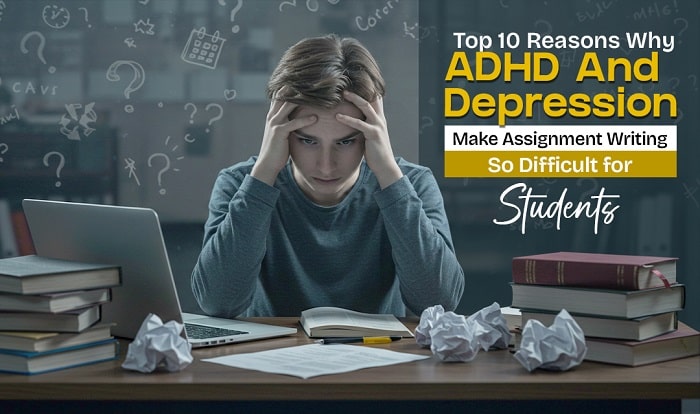

Read this article to discover how ADHD and depression increase assignment stress for students. Explore practical ways students can manage both effectively.
Do you know that around 6.1 million U.S. children have been diagnosed with ADHD? According to the National Institutes of Health (NIH), nearly 9.4% of children between the ages of 2 and 17 are affected.
These numbers highlight how widespread ADHD is and how often it quietly interferes with learning. Many young minds manage school tasks while having mental strain. Their mental health conditions, like ADHD and depression, make daily tasks quite difficult to perform. This article will explore how ADHD and depression increase assignment stress. Let’s get started with the important highlights.
Important Points Discussed
- Students with ADHD and depression fail to complete the assignment.
- Low motivation and emotional stress delay students’ progress and add pressure.
- ADHD causes time blindness, so students often miss deadlines and feel even more stressed.
- Depression lowers energy and confidence, making simple writing tasks feel harder than they are.
- Fear of failure grows when students struggle to keep up with schoolwork and deadlines.
- Depression can cause students to avoid people, so they miss out on helpful support.
- Building small daily habits and structure helps students manage ADHD and depression better.
- The first step is to notice the problem, then start with small steps to move forward.
What is ADHD?
According to the National Institute of Mental Health, “ADHD is a developmental disorder that causes inattention, hyperactivity, and impulsivity that affect daily life.” This condition arises early in childhood and continues into adulthood. It negatively affects how children focus, control impulses and emotions.
As stress builds up, it affects sleep and overall academic progress. Therefore, many students look for help to complete their academic tasks from professional assignment writing services in the UK. Experts provide support and guidance to reduce academic overload and save students from burning out.
Furthermore, children with ADHD usually miss details, forget tasks, and feel restless. Moreover, experts categorise ADHD into three main types:
- Primarily inattentive,
- Primarily hyperactive‑impulsive
- Combined type
Although some people grow out of certain symptoms, many continue to experience challenges through adolescence and adulthood.
ADHD particularly affects planning, motivation, and self-regulation in students. Therefore, not all students are lazy to do tasks, but they may have a neurodevelopmental condition.
What Is the Difference Between ADHD and Depression?
ADHD and depression are mental health conditions, and they affect the person in different ways. ADHD affects a person’s impulse control and daily tasks. He cannot sit still, stay focused, or finish tasks.
On the other hand, a person with depression feels sad, has low energy, and is uninterested in daily activities. Depression affects a person’s mood and emotions, so they feel isolated, tired and lack motivation.
Moreover, ADHD develops in early childhood, while depression can develop at any age of life due to trauma. A person can have both ADHD and depression. Therefore, accurate diagnosis is important to provide the right support, therapy, or medication.
How ADHD and Depression Magnify Assignment Stress? Top 10 Reasons
Students with ADHD and depression feel more stress than others while working on assignments. They fail to manage time because of low motivation, which makes simple tasks like essay writing difficult.
Now, let’s move to the top 10 reasons why ADHD and depression make assignment writing most difficult.
- The Mental Block Before Starting Work
Students with ADHD and depression often find it hard to start schoolwork, even when they want to. Due to ADHD effects, their focus quickly shifts, and they feel mentally restless. As a result, their minds cannot stay on one thought for long.
This restlessness begins the problem by draining energy and lowering motivation to begin anything. For that reason, the academic tasks that seem small to others can exhaust them. Therefore, they often avoid tasks that add to their anxiety and guilt.
Many of the students have what’s known as high-functioning depression, where they seem fine but feel empty inside. They may complete work, but every step is difficult behind the scenes. This hidden struggle causes silent pressure that others do not understand.
Moreover, when they try to concentrate on their academic responsibilities, this can lead to mental shutdown and increased stress. The more they push themselves to focus on their studies, the worse the symptoms become. This cycle can repeat for days or weeks without improvement.
At the end of this vicious cycle, students get bad grades. And teachers only see results; they don’t see the invisible battles students fight daily. Therefore, to help students manage ADHD and depression, the first thing that they should do is to recognise the unseen challenges that students are facing.
- Forget Instructions and Deadlines
Since ADHD affects working memory, students often forget assignment instructions or lose track of due dates. They may start one task but forget important details before finishing it.
Depression can make this worse by slowing thinking and making the brain feel foggy or unfocused. Moreover, students may struggle to process or hold onto information when they feel low or unmotivated. That is why they miss deadlines, leave work incomplete and repeat mistakes in school.
Here are the common problems they face:
- Forget classroom instructions
- Miss important deadlines
- Struggle to organise work
Sometimes these mistakes are overlooked, but they can be symptoms of deeper struggles with ADHD and depression.
Furthermore, constant forgetfulness creates a fear of failure, which discourages students from trying. They are always confused about whether to start an assignment or not, and without the proper support. This cycle of confusion and stress keeps repeating.
Teachers and parents must understand these common symptoms. This understanding enables them to help students reduce assignment pressure.
- Feel Stressed by Simple Tasks
Students with ADHD and depression often feel worried even when they have easy tasks. Although the others find that work small, affected students find it stressful.
Since mental disorders affect thinking and energy, short assignments can feel impossible to do. ADHD causes constant distractions, while depression lowers energy and increases emotional fatigue.
Therefore, focusing for even ten minutes can feel like running a mental marathon. These combined effects of ADHD and depression turn routine homework into a frustrating and draining experience. This experience eventually led students to overwhelming conditions, which caused the following:
- Avoiding assignments or pushing them off repeatedly
- Starting tasks but stopping midway due to stress
- Saying the work is “too much”, even if it looks simply
This intense mental overload is a symptom of how ADHD and depression affect the brain. Furthermore, emotional burnout often builds up because of ADHD, which leads students to shutdowns, isolation, or outbursts of anger.
In some cases, this can show up as postpartum rage or emotional dysregulation in teens and young adults. Although the task remains the same, the brain’s capacity to handle it keeps changing day to day.
Hence, schools and families need to understand this emotional overload to give better support so that students can rebuild confidence and lower stress.
- Emotional Reactions to Academic Pressure
Students with ADHD and depression show intense emotional responses whenever they have academic stress. Their mental conditions also affect their moods, so they react even to small problems.
Also, if they miss a deadline or receive criticism, this may lead to frustration, anxiety, or emotional shutdowns. Moreover, many students feel shame or guilt when they fall behind, which makes emotions harder to control.
They may cry easily, get irritated, or completely withdraw from class discussions or group activities. Teachers might see this as disrespect, although it usually reflects inner emotional distress.
Common emotional reactions include:
- Sudden anger or irritability after poor grades or negative feedback
- Crying or shutting down when overwhelmed
- Avoiding tasks due to fear of failure
This pattern sometimes develops into depression and anger, especially when students feel unsupported or misunderstood. Therefore, emotional struggles often go unnoticed until they begin to affect school attendance and daily functioning.
Furthermore, emotional outbursts may be misinterpreted as behaviour issues instead of symptoms of ADHD and depression. Create a calm learning space to help reduce triggers and build emotional resilience in students. So, students gain control and confidence in the classroom.
- Hiding Struggles Behind a Smile
Students with ADHD and depression hide their struggles and act like everything is fine. They may smile in class and laugh with friends while having silent stress. This is often called smiling depression, where a person appears fine but feels broken inside.
Many students with ADHD and depression don’t show clear signs, so teachers and classmates often miss the warning signals. Because of this, these students rarely receive the help they actually need.
They also feel pressure to do well in school while their mental health keeps getting worse. Over time, this pressure builds up and adds to both their emotional and academic stress.
You may notice the following hidden signs in students with ADHD:
- They act like everything is fine and do not ask for help
- They complete their tasks but feel drained inside
- They join social events but still feel completely alone
Even though they appear to manage things well, inside, they’re fighting a constant battle. In addition to this, many students fear being judged or labelled as weak if they speak up about their ADHD or depression.
So, when they hide what they’re going through, they miss the chance to get real support and understanding. Schools also lose the opportunity to step in early with the right help.
That’s why teachers need to know that not all struggles are easy to spot. A student who looks strong on the outside might be breaking down inside.
- Feeling Isolated While Others Keep Up
Students with ADHD and depression feel left behind while their classmates finish work easily. Undoubtedly, they work hard to stay in the competition, but the fact is that their progress is slower. This leads to feelings of shame and isolation. This emotional gap grows when they compare themselves to others who seem to handle tasks without struggle.
This not only stops here, but with the fluctuation of focus and energy, these students may miss group work, deadlines, or class instructions. They feel embarrassed to ask for help or explain their challenges to peers. Their hesitation and battle with themselves build a wall between them and other students that causes emotional distance.
The common behavioural traits of students with ADHD and depression involve:
- They sit quietly during group work and class activities.
- To avoid embarrassment, they often skip school.
- They avoid conversations about schoolwork with friends.
All these habits can lead to deep loneliness over time, even when surrounded by people. Knowing how to cope with this loneliness becomes essential for students trying to survive school with hidden challenges.
Apart from that, with this kind of behaviour, other people think the student is lazy and uninterested in studies. However, this misjudgment only increases pressure and emotional pain for students facing ADHD and depression.
Building safe spaces and listening without judgement helps break this isolation. Because every student deserves to feel seen and supported, no matter how quiet their struggle appears.
- Trouble Sleeping Affects Mental Focus
Many children with ADHD and depression have trouble falling and staying asleep during the night. Their minds stay active, racing with thoughts or emotions that make rest nearly impossible. This lack of sleep creates mental fog, which affects motivation for schoolwork.
Moreover, a tired brain fails to manage memory, attention, and emotional control throughout the school day. Although assignments may be simple, they find them confusing and impossible to finish. So, they started to give intense emotional reactions that make stress worse.
Students with ADHD also face the following problems:
- They have morning depression which makes it harder to get up and prepare mentally for school tasks.
- Children wake up tired, low on energy, and unwilling to do classwork.
- They may delay tasks, which increases pressure.
All these problems get worse over time and lower classroom performance. So, students feel anxiety about what if they fall behind, which further disrupts their sleep patterns. Since sleep fuels the brain, poor rest affects both emotional balance and academic progress.
Therefore, students trapped in this pattern need more support from both home and school. Proper rest, combined with care for their mental health, can ease pressure from school assignments. Improve sleep hygiene to reduce the negative effects of ADHD and depression on academic success.
- Fear of Failure Increases Pressure
Students with ADHD and depression feel that failure is just one mistake away from them. This fear grows with every missed deadline. So, students with ADHD find all tasks difficult to do. They also have a constant fear of failure, so they do not even start the assignments.
Also, students with ADHD face the following problems:
- They do not finish the assignment because they think they may fail to complete it.
- Usually, they delay their assignment to avoid the stress.
- They have a deep fear of being judged while doing an assignment.
Moreover, they may compare themselves with others and feel they’re always falling behind. Since they struggle more than their peers, they begin to expect failure, not success. This mindset causes pressure and weakens their ability to try something.
Although they may seem unmotivated, the truth is they’re scared of not doing things right. This fear can grow into high-functioning depression, where students hide stress behind quiet effort. They may smile outside but feel empty inside, fearing that no one understands their struggle.
Therefore, the constant pressure from fear can stop real progress. These children need encouragement, not judgment, to rebuild trust in their own abilities. Support and understanding help them break this fear cycle caused by ADHD and depression.
- Social Withdrawal Blocks Academic Support
Children dealing with ADHD and depression often isolate themselves in school or college settings. This social withdrawal makes it harder to reach out when they actually need help the most. Although support exists, they may not feel confident enough to ask for it.
- They avoid group discussions or teacher interaction.
- They skip classes and stay silent in online learning spaces.
- Their isolation leads to a lack of learning and feedback.
- Their isolation causes a lack of learning and feedback.
Also, these students have morning depression or emotional lows, so they do not like to connect with others. When they do not talk to peers, mentors, and tutors, the academic pressure increases.
Students with mental conditions usually don’t seek health professionals because of fear or shame. This behaviour fuels emotional withdrawal and leads to academic decline, which worsens their self-worth. They may even take depression quizzes online instead of seeking real help.
To break this pattern, emotional safety and open communication must be built into school environments. Only then can students with ADHD and depression feel safe enough to ask for support.
- Low Energy Levels Reduce Learning Capacity
Students with ADHD and depression experience exhaustion and mental fatigue. Their brains do not focus on one task, and they fail to manage their emotions. So, this constant effort quickly drains their energy and lowers their ability to learn. Also,
- They feel tired even after a full night’s sleep.
- They may experience morning depression to get out of bed for school.
- Tasks that once seemed easy now feel exhausting.
Since both conditions affect motivation and concentration, simple assignments feel like heavy burdens. Moreover, poor sleep linked to ADHD worsens symptoms of high-functioning depression during study time. Therefore, energy becomes a limited resource, and it’s mostly spent just trying to stay afloat.
Learners with ADHD spectrum challenges also tend to overthink or replay small mistakes. This leads to mental burnout and lowers their ability to process new academic information. Furthermore, the combination of restlessness and sadness can lead to post-surgery depression after major life changes.
What is Depression, and What are the Types of Depression?
Depression is a serious mental health disorder that affects a person’s feelings and behaviour. According to the National Institute of Mental Health (NIMH), “Depression causes sadness in people and they lose interest in activities. It can also affect sleep, appetite and focus.”
Children and adolescents with depression may struggle in school, avoid friends, or lose interest in hobbies. Since symptoms last for weeks or months, depression often disrupts academic development.
Moreover, depression in young people can be difficult to recognise because symptoms may appear as irritability or fatigue.
- Major Depressive Disorder (MDD) is the most common form. People with MDD feel hopeless. They may have sleep problems and difficulty concentrating. These symptoms must last at least two weeks and affect daily life.
- Persistent Depressive Disorder (Dysthymia) is a long-term form of depression. Although symptoms are usually milder, they can last for years and impact mood, motivation, and focus.
- Seasonal Affective Disorder (SAD) often appears in winter, triggered by shorter daylight hours and cold weather.
- Premenstrual Dysphoric Disorder (PMDD) affects some females before menstruation, so they experience mood swings and sadness.
- Postpartum Depression starts after childbirth and affects the emotions of children.
Therefore, early diagnosis can protect mental health and improve the academic performance of affected children. So, parents must understand depression types to recognise symptoms early.
How to Handle Assignment Stress Caused by ADHD and Depression?
Living with ADHD and depression makes schoolwork more draining than usual. However, use the right strategies to control back and reduce the stress students feel each day.
Here are simple ways to stay on track:
- A clear to-do list helps stop the feeling of being lost during work.
- Work for 20 minutes, then take a 5-minute break
- Finish a simple part to boost confidence and motivate students
- Quiet spaces can block out distractions.
- Talk to a depression therapist to build coping skills that ease pressure during stressful weeks.
They may start homework writing but abandon it halfway through due to exhaustion. To such students, we suggest that they reach out to UK-based assignment writing platforms, such as The Academic Papers UK, Affordable Dissertation UK, or Cheap Essay Writing UK. Their experts handle the assignments while students can work on their mental health.
Final Words
ADHD and depression cause a heavy burden that makes academic life harder for many students. They affect memory, concentration, and energy, which makes you less motivated. So, their emotional lows interrupt study routines, and they fail to handle assignments.
However, students with ADHD can handle academic stress through the right strategy. They can fight back the stress by making a good study plan.
Also, they should develop healthy habits to improve mental performance over time. They must get enough sleep, stay physically active, and eat well. Furthermore, they should practice mindfulness and relaxation techniques to lower anxiety. With the right approach, students can reduce stress and handle their assignments more confidently.
FAQs
Can Having ADHD Cause Depression?
Yes, ADHD can develop into depression because it causes low self-esteem, academic failure, and frustration. Over time, these issues can lead to sadness and hopelessness.
If someone with ADHD feels misunderstood, they may start to withdraw emotionally. This emotional pressure can build into depression if left untreated. Therefore, it’s important to manage ADHD early to prevent depression.
What is Deep ADHD Shutdown?
Deep ADHD shutdown happens when your brain reaches a breaking point. You may feel stuck starting tasks, and you feel emotionally overloaded. This isn’t just procrastination, but it’s your brain’s response to mental overload. You may find small tasks impossible during an ADHD shutdown.
Many people experience guilt, which can make the cycle worse. So, it is important to manage stress before it gets too intense.
How to Get Out of Depression When You Have ADHD?
Remember, recovery always starts with small steps. Make a routine, follow simple steps, and celebrate small wins. Get regular sleep and eat healthy meals. Do physical activity to lift your mood and boost your focus.
Additionally, write down your thoughts to understand your emotional triggers. You can also consider therapy or medical treatment options.
What to treat first, ADHD or depression?
It depends on which condition affects your daily life more. If depression affects your daily life activities, treat it first. Stabilising mood can help you follow through with ADHD treatments.
However, if ADHD leads to emotional burnout, addressing ADHD may ease the depression. A mental health professional provides a plan that fits your unique needs and goals.